
The FOIL Framework for New York County Public Records
New York runs two separate access systems. One covers government agencies. The other covers the courts. The Freedom of Information Law, found in Public Officers Law Article 6, governs agency records only. It does not reach court case files. That split matters in Manhattan because so many records people want sit with the courts or the County Clerk, not with an executive agency.
The core rule lives in Public Officers Law § 87. It tells every agency to make its records open to the public, then lists the cases where access can be denied. Those exemptions include an unwarranted invasion of personal privacy, interference with a law enforcement investigation or a court case, trade secrets, and public safety. So a FOIL request to an NYC agency can succeed in full, in part, or be denied if an exemption applies. The image below comes straight from the state Senate text of that statute.
Section 87 is the reason a request to the NYPD or the Department of Finance Sheriff can return a redacted file rather than a full one. Agencies must point to a specific exemption when they hold back any part of a record.
Note: FOIL covers agency records, not court case files; a Supreme Court case file is requested through eCourts, NYSCEF, or the County Clerk instead.
FOIL Records vs New York County Court Files
The line between a FOIL record and a court file trips up many requesters. Pick the wrong office and the request stalls. The table sets the two apart by what the record is, who holds it, and how to ask.
| Point | FOIL Agency Records | Court Case Files |
|---|---|---|
| Governing law | Public Officers Law Article 6 (FOIL) | Court rules, sealing statutes, common-law access |
| Who holds it | NYPD, NYC DOC, Dept. of Finance Sheriff, other agencies | The courts, the County Clerk, Surrogate's Court |
| How to ask | Written FOIL request to the agency records officer | eCourts, NYSCEF, or a clerk request |
| Examples | Arrest reports, body-camera logs, agency policies | Index files, judgments, motions, dispositions |
| Denial path | FOIL appeal under § 89, then Article 78 | Motion to the court; sealing law applies |
For court material, the better starting points are the New York County court records portals and the New York County Clerk page. Criminal arrest paperwork is split: the court docket sits with the criminal courts, while an arrest report often comes from the NYPD by FOIL. That overlap is covered on the arrest records page.
How to File a FOIL Request in New York County
A FOIL request goes to the agency that holds the record, not to a central city office. Each NYC agency names a records access officer who logs the request and starts the clock. The procedure that controls timing, denials, and appeals sits in Public Officers Law § 89, pictured below.
Section 89 is the section a requester cites when an agency goes silent or denies a record. The steps below follow its basic flow for a Manhattan agency such as the NYPD, NYC DOC, or the Department of Finance Sheriff.
- Find the right agency. Match the record to the body that made or keeps it. Arrest data goes to the NYPD; jail data goes to NYC DOC; sheriff and tax-collection files go to the Department of Finance.
- Write the request. Name the records as plainly as you can. Dates, locations, report numbers, and names help staff find the file faster.
- Send it to the records access officer. Most NYC agencies take requests by an online portal, email, or mail. Keep a copy and the date you sent it.
- Wait for the acknowledgment. Under Section 89 the agency must reply within five business days. The reply may grant the request, deny it, or set a date when it will respond.
- Pay any copy fee. The agency tells you the cost before it makes copies. Standard copies run up to 25 cents per page.
- Appeal a denial. If the agency denies the request or stays silent, file a written appeal to its FOIL appeals officer within 30 days, then seek Article 78 court review if still denied.
The whole path is meant to move without a lawyer. Most requesters never reach the appeal step.
New York County Clerk Records Beyond Court Cases
The County Clerk does more than hold Supreme Court files. The office is also the Commissioner of Jurors, issues passports, certifies records, and keeps several record sets that have nothing to do with a single court case. Many of these are open to anyone who pays the copy fee.
Business filings are a big part of the job. The Clerk keeps certificates of doing business, often called DBA or assumed-name filings, for sole proprietors and partnerships in Manhattan. The office also maintains the judgment and lien docket. That docket can hold money judgments, transcripted judgments, mechanic's liens, hospital liens, notices of pendency, and satisfactions. A search certificate from the Clerk confirms what the docket shows for a name.
- Business and DBA filings: certificates of doing business for sole proprietors and partnerships.
- Judgment and lien docket: money judgments, mechanic's liens, hospital liens, and notices of pendency.
- Search certificates: an official statement of what the judgment and lien docket shows.
- Naturalization records: older citizenship papers filed with the Clerk before federal centralization.
- Court case files: Supreme Court records kept in the Record Room at 60 Centre Street.
One record type is not here. Deeds, mortgages, and other real property documents for Manhattan are not filed with the County Clerk. They sit with the New York City Department of Finance in the ACRIS system. A property records search for a Manhattan address starts there, not with the Clerk.
Note: Manhattan real property records such as deeds and mortgages are kept by the NYC Department of Finance in ACRIS, not by the New York County Clerk.
New York County Public Records Fees
Fees depend on the record and the office. FOIL copies from a city agency run up to 25 cents per page under the standard rule. The County Clerk charges its own schedule for copies, certifications, and certificates. The list below comes from official County Clerk fee sources.
| Item | Fee |
|---|---|
| Photocopy or public terminal print | $0.25 per page |
| Private copy machine, some older or off-site files | $0.35 per page |
| Certification | $8 plus $0.25 per page |
| Certified copy of Business Department records | $10 plus $0.25 per page |
| Certified copy request by mail | $8 |
| Search certificate | $5 per two years searched |
| Certificate of disposition of judgment | $10 |
| Certificate of non-appeal | $5 |
| Exemplification in person | $33 plus $0.25 per page |
| Business certificate filing | $100 |
Payment rules are strict at the Clerk's office. The office takes cash, certified check, attorney check, credit card, money order, or official bank check made out to the New York County Clerk. Personal and company checks are not accepted. Credit-card payments carry a 2.99% surcharge.
What a New York County Records Request Asks For
A counter request at the County Clerk Records Department uses a short requisition form. The fields are simple, but the index number is the one that makes retrieval fast. Without it, staff search by party name and approximate year, which takes longer for older files. The form-field inventory comes from the Clerk's described counter form.
| Field | What It Asks For |
|---|---|
| Plaintiff / Petitioner | Name of the party who started the matter. |
| Defendant / Respondent | Name of the responding party. |
| Case Index Number | Strongly recommended; examples 12345/1985 or 123456/2010. |
| Requester's Name | Name of the person asking for the file. |
| Telephone Number | Used for an off-site file callback. |
| Type of Identification Provided | State or country-issued ID, held briefly during inspection. |
| Email Address | Used for availability questions and follow-up. |
For inspection, the staff may hold a state- or country-issued ID while the file stays in the requester's hands. A divorce or name-change file carries extra rules and proof. Those record types are detailed on the marriage and divorce records page.
Sealed and Confidential New York County Records
Open access has limits. Some records are sealed by statute, which keeps them out of any ordinary FOIL or court search. Criminal sealing is the most common reason a case will not appear. After a case ends in the accused person's favor, CPL § 160.50 requires sealing of the court, police, and prosecutor records. A conviction for certain noncriminal violations gets sealed under CPL § 160.55, shown below.
That statute limits who can see the file while leaving narrow access for some government uses. Treatment-based dispositions can also lead to sealing. CPL § 160.58 provides conditional sealing for certain drug, marijuana, and related offenses after a successful program, as the next image shows.
Conditional sealing can be lifted if a later condition is broken. A separate path lets a person petition to seal certain older convictions. CPL § 160.59 sets up that petition route, pictured below, and the courts note a $10 fee for a sealing application filed within the five boroughs.
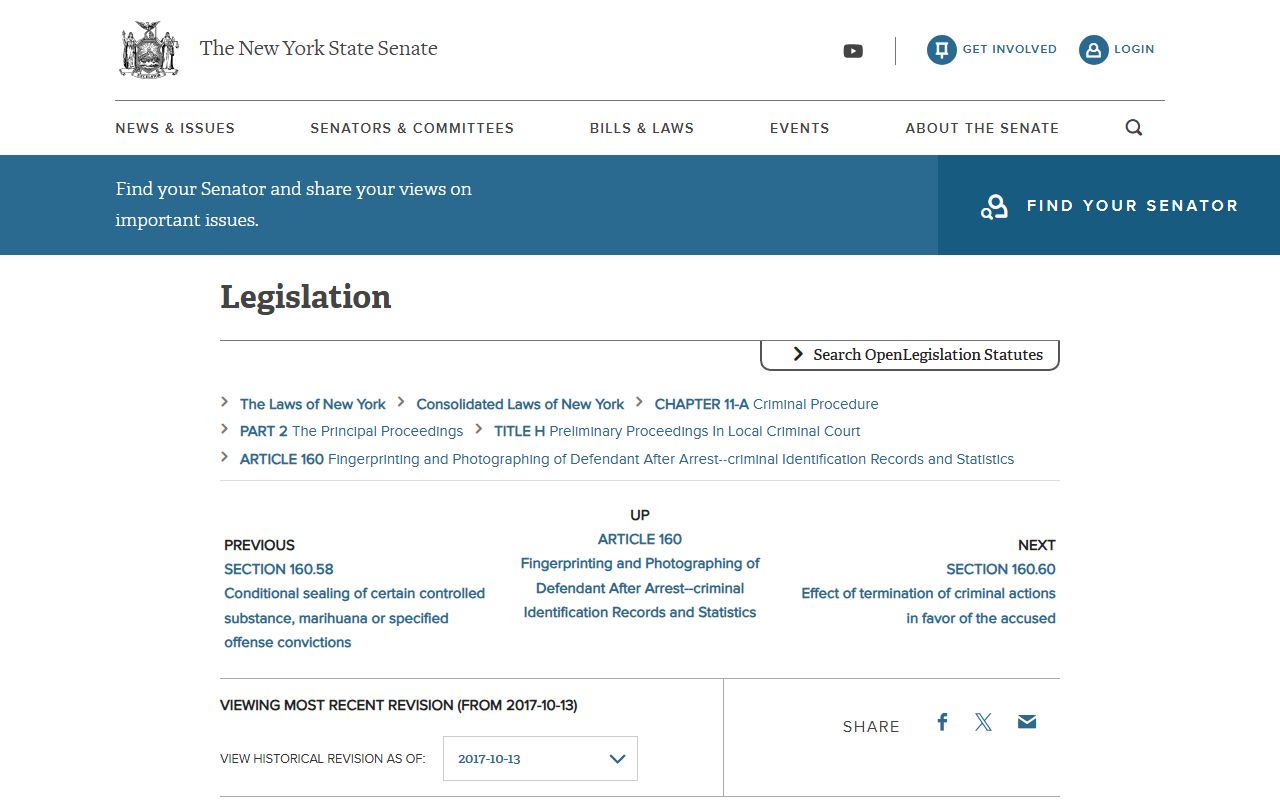
Section 160.59 excludes sex offenses, Class A felonies, violent felonies, and homicide cases. Other record types are confidential by their own laws. Matrimonial files stay closed under Domestic Relations Law § 235, Family Court files under Family Court Act § 166, and adoption files under Domestic Relations Law § 114.
Response Times and FOIL Appeals in New York County
FOIL puts firm deadlines on agencies. Under Public Officers Law § 89, an NYC agency must answer a request within five business days. The answer can grant it, deny it, or set a reasonable date when the records will come. A request for a big set of files may take longer, but the agency still has to acknowledge it and give a clear timeline.
When an agency denies a record, the requester has a right to appeal. The appeal goes in writing to the agency's FOIL appeals officer within 30 days of the denial. The appeals officer then has 10 business days to respond. If that fails, the next step is an Article 78 proceeding, a court case that asks a judge to review the agency's decision. None of this applies to court files. A sealed or confidential court record is reopened only by motion to the court that holds it, not by a FOIL appeal.
For arrest and criminal paperwork, the agency and court paths often run side by side. A person can ask the NYPD for an arrest report by FOIL while the criminal docket itself stays with the courts. The arrest records page and the court records page cover that split in more detail.