
Why There Is No Public New York County Warrant List
Many people expect a single name-search tool for warrants. Manhattan does not have one for criminal matters. The New York State Unified Court System is clear that WebCriminal does not show warrants, finished cases, or sealed cases. So a name search there will not surface a bench warrant, even when one is active. That is by design, not a gap in the data.
This catches people off guard. They run a search, see nothing, and assume they are clear. The correct path is different. To check a New York County warrant, a person reviews case status through WebCriminal, calls or visits the court clerk that handles the case, contacts counsel, or resolves the matter at the court directly. None of those paths is a one-click public lookup. They take a phone call or a visit.
Not every warrant is hidden, though. Civil tax warrants are public. The sex offender registry is public. The child support warrant notice system is public. The sections below split the warrant types apart so a search starts in the right place.
Types of New York County Warrants
The word "warrant" covers several very different documents. Some come from a criminal judge. Some come from a civil court. Some come from a tax agency. Lumping them together leads to dead-end searches, so it helps to keep them separate.
- Bench warrant. Issued by a judge, often after a person fails to appear in court. Bench warrants are governed by CPL 530.70.
- Arrest warrant. A legal document that authorizes apprehension of a named person. The NYC Sheriff handles certain arrest warrants and civil contempt warrants.
- Search warrant. Not a public lookup item. These are often sealed while an investigation is open.
- Civil or eviction warrant. A Housing Court warrant of eviction is based on a judgment of possession and lets a sheriff or marshal remove people from the premises.
- Tax warrant. A civil enforcement filing by the NY Tax Department. This one has a public search and should not be confused with a criminal arrest warrant.
- Child support warrant notice. A notice tied to child support or spousal arrears, run through a state notice system under tax collection provisions.
The first three are mostly criminal or court-controlled and stay out of public name searches. The last three are civil and have public-facing tools, which the next sections walk through.
New York County Tax Warrant Search
A tax warrant is the one warrant type with a clean public name search. The New York State Department of Taxation and Finance files tax warrants against people and businesses that owe back taxes. These are civil. They create a public lien and a public record, and anyone can look them up. The state runs a free tax warrant search on its enforcement pages.
The tool below is the official state portal for that lookup. It lets a user search by debtor name and narrow results by county and city.
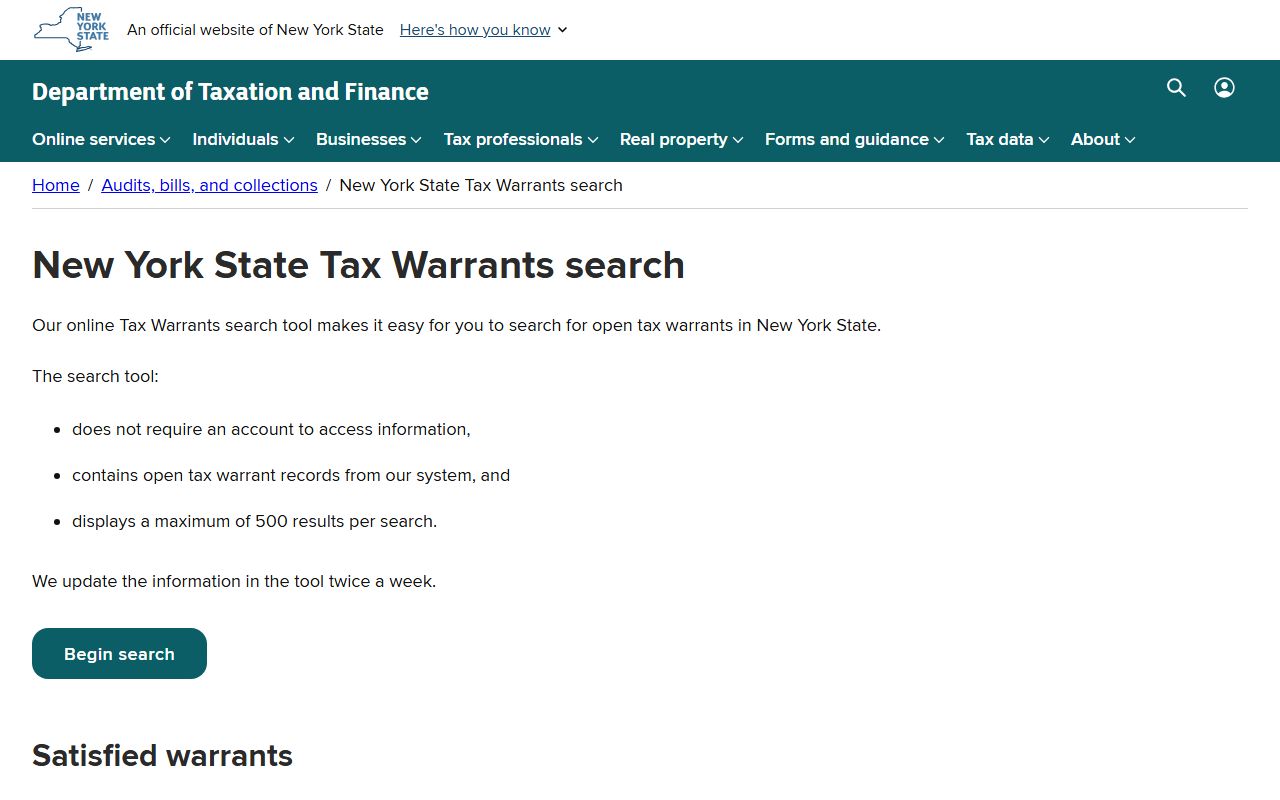
New York County may appear as the county of filing for Manhattan debtors. The search fields are short and simple, which the table lays out.
| Field Label | Type | Required | Notes |
|---|---|---|---|
| Taxpayer / Debtor Name | Text | Optional | Search by the name on the warrant. |
| County | Dropdown | Optional | Select the county of filing; New York County for many Manhattan filings. |
| City | Text or dropdown | Optional | Narrow results by the debtor's city. |
| Search | Button | No | Returns public tax warrant records that match. |
Note: When a tax debt is paid in full, the Tax Department satisfies the warrant and removes it from the public search tool.
What a New York County Tax Warrant Record Shows
A public tax warrant result returns a fixed set of fields. It is a civil record, so it shows debt and filing detail rather than charges or bond. The inventory below covers what a match displays.
| Field | What It Shows |
|---|---|
| Debtor / Taxpayer Name | The person or business named on the warrant. |
| County Filed | The county where the tax warrant was filed. |
| Warrant ID / Docket | The warrant identifier and docket information. |
| Amount / Docket Details | The debt amount and docket details where shown publicly. |
| Status | Open, or satisfied and removed once the debt is paid in full. |
Criminal bench and arrest warrants do not appear in any list like this. There is no comparable public field inventory for those because the public tool does not exist. To learn anything about a criminal warrant, the contact-the-court path is the only route.
Sex Offender Registry and New York County Warrant Status
The New York State sex offender registry is a separate public tool, run by the Division of Criminal Justice Services. It is not a warrant list, but people checking on a person's status often need it alongside warrant questions, and it does flag certain enforcement details. The public registry search lets anyone look up registered offenders by name and area.
The screenshot shows the official registry search page.
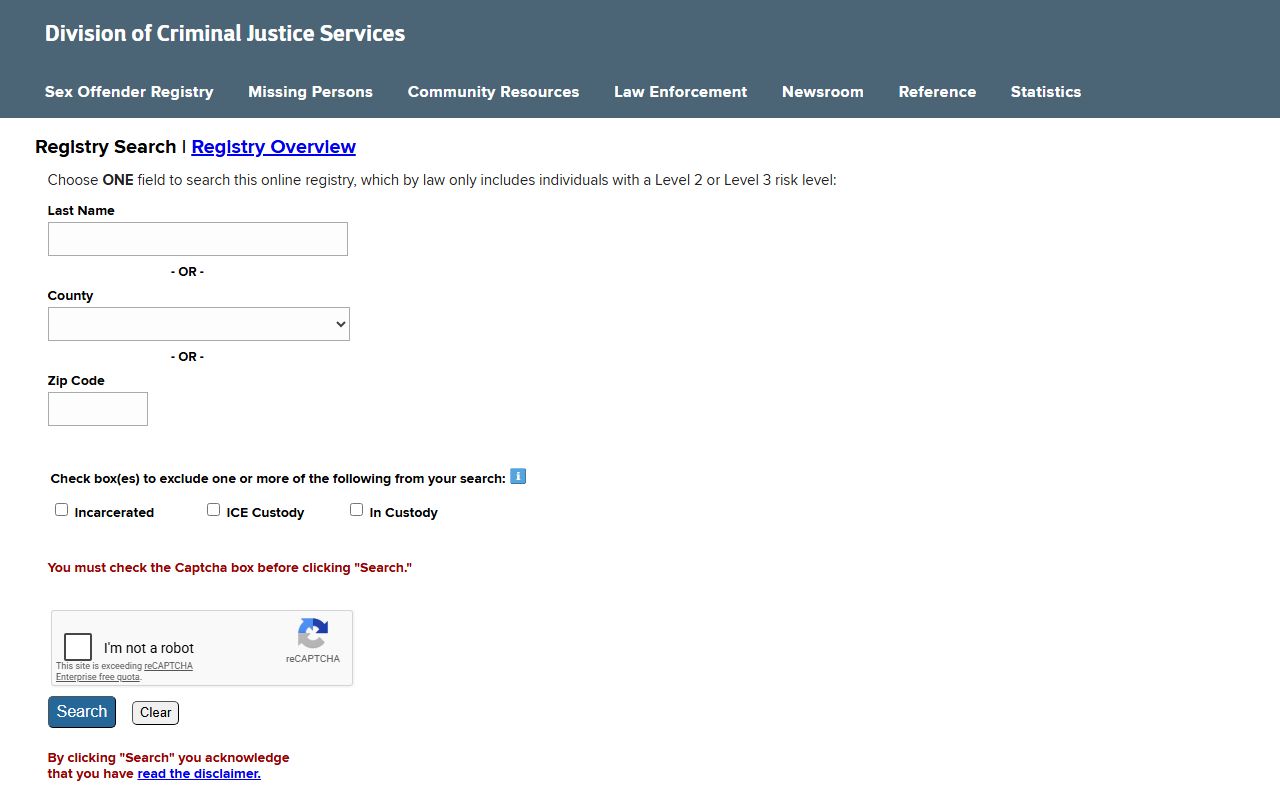
A name match returns registry level, address area, and conviction detail. It does not show open arrest warrants. For a person who has been booked into custody after a warrant is executed, the better follow-up is the New York County inmate records lookup, which tracks who is in DOC custody right now.
Child Support Warrant Notice System
New York runs a warrant notice system for child support and spousal arrears. The Department of State maintains it under tax law collection provisions. It is a public notice tool tied to people who owe support, and it sits apart from the criminal warrant world entirely. The official page is the state child support enforcement warrant notice system.
The image below shows that state notice system page.
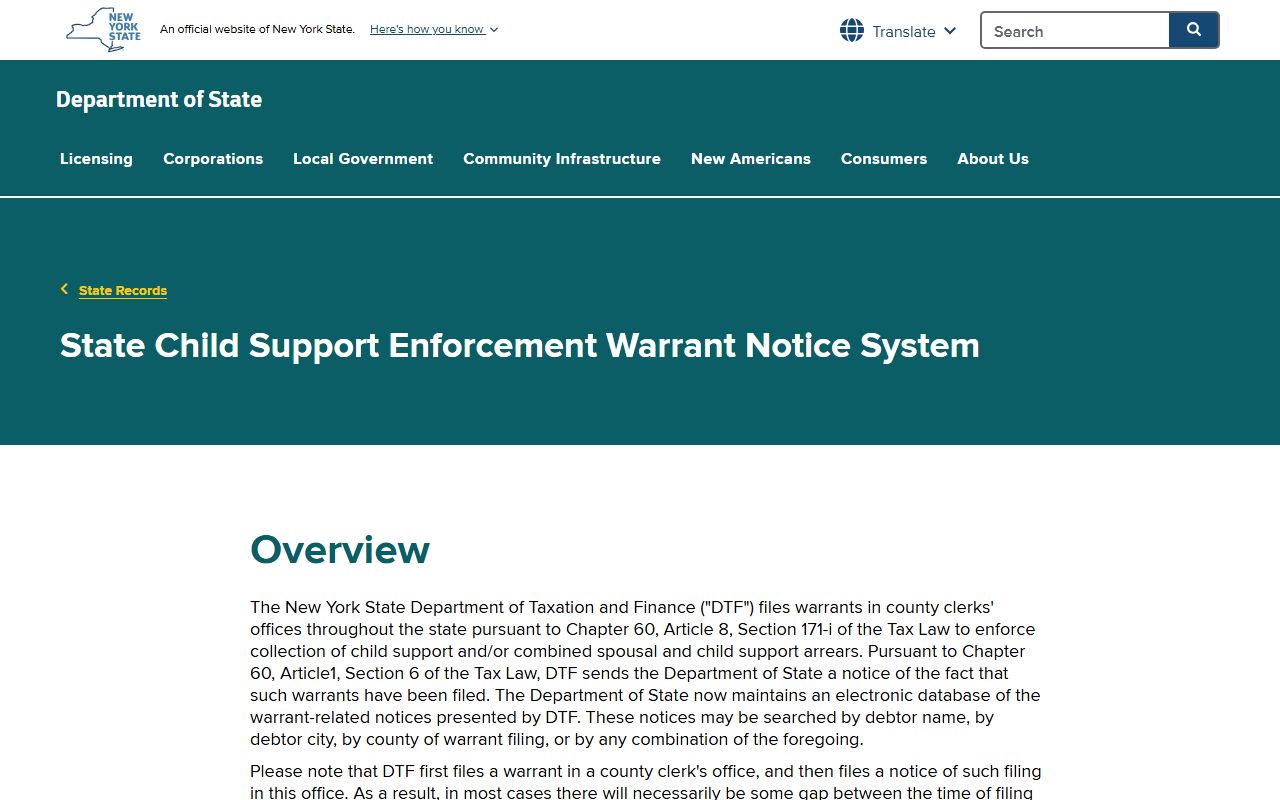
This system supports enforcement of unpaid support orders. A parent or party with a Manhattan support case may see notices here. It is civil enforcement, not a criminal arrest tool, so it will not show a bench warrant from a criminal case.
How to Check a New York County Bench Warrant
For a criminal bench or arrest warrant in Manhattan, there is no shortcut. The reliable steps run through the court itself. WebCriminal will not display the warrant, so do not treat an empty result as proof there is none.
- Skip WebCriminal for warrant checks. It excludes warrants, finished cases, and sealed cases.
- Identify the underlying court: New York Criminal Court, New York Supreme Criminal Court, Summons Court, Family Court, or another court.
- Call the right clerk. Criminal Court general information is 646-386-4511. The Summons Clerk is 646-386-4869 or 646-386-4950. The Midtown Clerk is 646-264-1330.
- Contact counsel, or apply for assigned counsel if you cannot afford a lawyer.
- Bring ID and case paperwork to any court visit.
- After the matter is resolved, confirm the court updated the docket, since data can lag.
The clerk can confirm whether a case has an open warrant and what the next step is. That phone call does what no public search can.
What to Do If You Have an Outstanding Warrant
An open warrant does not go away on its own. The most common one is a bench warrant for a missed court date. The way to clear it is to address the underlying case, usually by appearing before a judge. The exact result depends on the charge, the warrant history, and current law.
Get legal advice first. Counsel can tell a person what to expect, file to vacate a warrant where appropriate, and arrange a controlled return to court. If a person turns themselves in, they should plan for possible detention until the court takes up the warrant. Bail and release conditions vary case to case. Bring ID and any case paperwork.
Important: Talk to a lawyer before you surrender on a warrant; counsel can often arrange the appearance and explain the likely outcome first.
Restricted New York County Warrant Records
Several warrant categories stay closed to the public for legal reasons. Search warrants are commonly sealed during an active investigation, so they are not a lookup item. Criminal records sealed under CPL 160.50 or CPL 160.55 drop out of public searches once a case ends in the person's favor or with a noncriminal outcome.
Court access in New York follows its own rules under the Unified Court System's public access guide, not the agency Freedom of Information Law. FOIL covers agency files such as NYPD or sheriff administrative records under Public Officers Law § 87, but it is not the path for a court warrant. Juvenile and Family Court matters carry their own confidentiality. Federal warrants are handled by federal agencies and do not appear in any state or city tool.